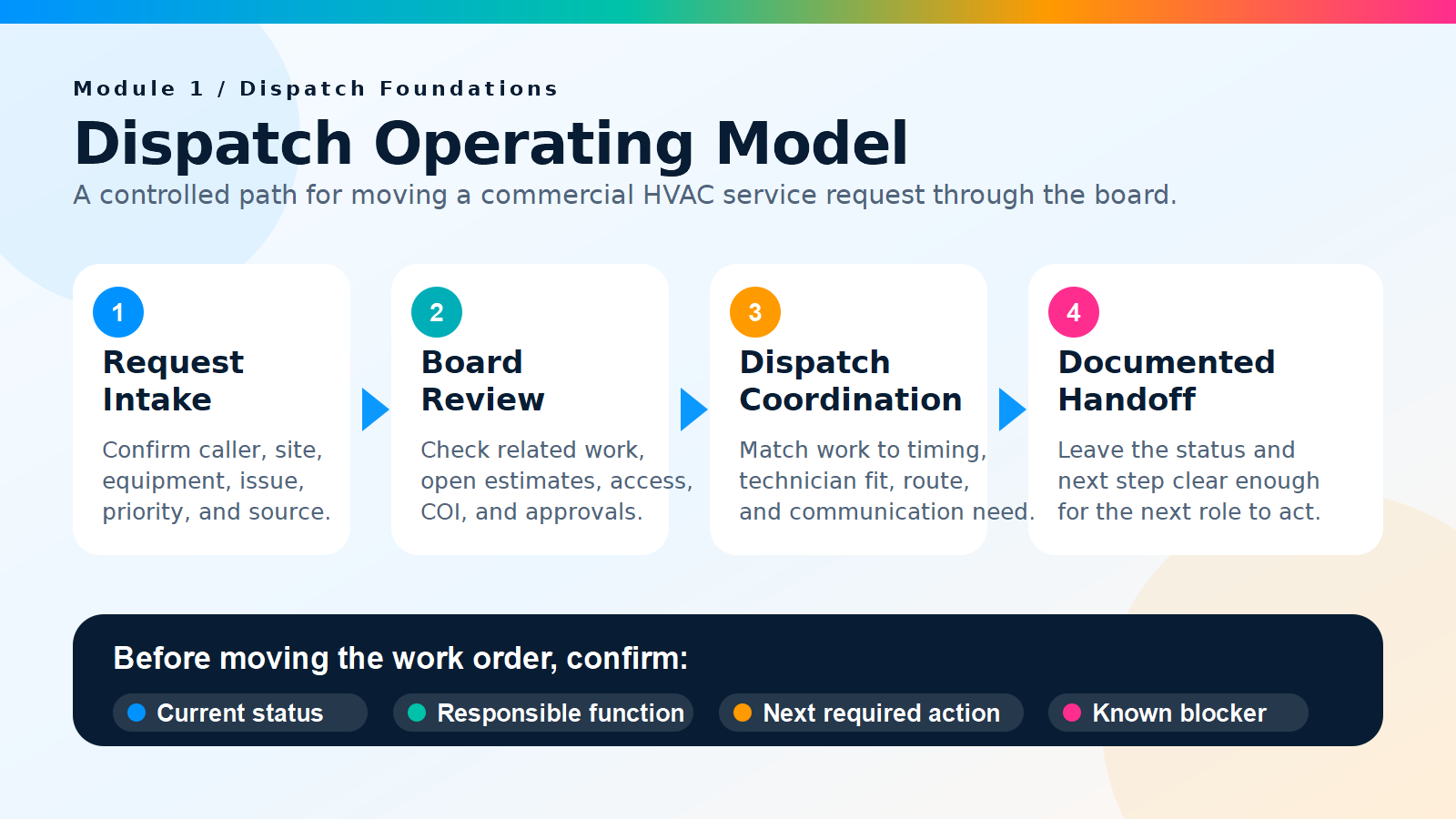

This free HVAC dispatcher training manual follows a service call from the first customer conversation through scheduling, technician updates, and closeout. Use the seven-step workflow and daily checklists to train a new dispatcher or review how your team handles service calls.
Add your company software steps, service area, customer commitments, on-call rules, approval limits, and escalation contacts. Those details belong in the operating procedure beside this guide.
What an HVAC dispatcher controls
The dispatcher keeps the service board current: where each technician is, which jobs are ready, what customers have been promised, and what needs attention next. Field diagnosis belongs with the technician; decisions about staffing, pricing, or exceptions may need a service manager. The HVAC dispatcher role guide explains the responsibilities in more detail.
What the customer needs, how urgent it is, and what has already been promised.
Which technicians are available, where they are, and what work they can complete.
Whether access, parts, equipment, approvals, contacts, and instructions are in place.
Whether the job has a current status, clear owner, useful note, and next action.
The seven-step HVAC dispatch workflow
- Capture the request.
Record the site, caller, contact method, equipment or area affected, symptoms, access limits, purchase-order requirements, and any commitment already made.
- Classify priority.
Separate true emergencies from urgent and routine work. Use defined criteria such as safety risk, complete loss of critical service, property exposure, and customer-specific response obligations.
- Confirm readiness.
Before scheduling, verify that the technician can arrive and perform useful work. Check access, contacts, parts, special equipment, permits, approvals, and job instructions.
- Match the work.
Choose a technician using skill fit, geography, remaining capacity, current job status, promised window, and the likely duration of the work.
- Set the plan.
Document the arrival window, expected scope, customer contact, special instructions, and what should happen if the plan changes.
- Control the active board.
Monitor travel, arrival, diagnosis, authorization, parts, completion, and blocked status. Review exceptions before they become missed commitments.
- Close or hand off.
Confirm notes, status, customer communication, follow-up ownership, required parts or quotes, and the next date or action before leaving the job untouched.
Example: a work-order note before dispatch
Customer reports warm air from the front-office system. Site contact: Jordan, available until 4:00 p.m. Check in at reception for roof access. Diagnostic visit approved up to the amount recorded on the work order; call the manager before additional work. Arrival window: 1:00-3:00 p.m. Dispatcher to update Jordan by 12:30 if the window changes.
This example records the reported problem, access, approval, and customer promise. Once the technician diagnoses the fault, add the findings and any repair or return-visit requirements to the same work order.
Use a job readiness gate before scheduling
Before assigning a technician, confirm what the visit requires. A diagnostic call needs a useful problem description, access, and authorization. A planned repair also needs the specified parts and equipment. Missing either can mean a wasted trip.
Minimum readiness check
- Correct site, address, and service contact
- Useful problem description and equipment context
- Access instructions and operating-hour limits
- Required authorization, purchase order, or not-to-exceed amount
- Parts, rental equipment, permits, or vendor coordination confirmed when required
- Technician skill and time requirements understood
- Customer promise documented
If something is missing, record what is needed, who will obtain it, and when to follow up. For example: “Waiting for roof-access approval; dispatcher to call the site manager at 10:00 a.m.”
When to review the dispatch board
| Review point | What to confirm | Expected result |
|---|---|---|
| Start of day | Technician availability, overnight calls, first-job readiness, parts, access, and promised windows | A realistic opening plan |
| Mid-morning | Late arrivals, jobs running long, unassigned demand, and new emergencies | Early corrections before the schedule breaks |
| Midday | Remaining capacity, second-half routes, approvals, parts, and customer updates | A deliberate afternoon plan |
| Late day | Open jobs, return visits, incomplete notes, on-call handoffs, and tomorrow readiness | No job left without an owner and next action |
Between formal reviews, work from exceptions. A dispatcher should be able to identify which jobs are late, blocked, missing information, at risk of missing a promise, or waiting beyond their review threshold.
Keep customers and technicians updated
Useful dispatch communication tells the receiver what changed, what it affects, what happens next, who owns that action, and when the next update is due.
Status + impact + next action + owner + time.
“The technician is still on the prior repair and is now expected at your site between 2:30 and 3:00. I am monitoring the call and will update you again by 2:15 if that window changes.”
Record meaningful updates in the work order. Private messages and verbal conversations may help in the moment, but the operating record must remain usable by the rest of the team.
Handle emergency calls without losing the whole board
Use written emergency criteria. Confirm the immediate risk, site contact, access, affected equipment or area, operational impact, and any safety instruction already provided by authorized personnel. Then compare the emergency with the active schedule instead of automatically sending the nearest technician.
- Validate severity using the company definition.
- Identify the technician with the right skill and a workable route.
- Decide which existing commitment will move.
- Notify every affected customer and technician.
- Document the decision, owner, and next review time.
After assigning the emergency, update the customers whose appointments moved and give each displaced job a revised plan.
Daily HVAC dispatcher checklist
Before dispatching
- Review technician attendance and capacity
- Confirm first jobs are ready
- Check overnight and priority calls
- Review parts, access, and special equipment
- Identify schedule risks
Before leaving the board
- Resolve or hand off every active exception
- Confirm customer updates are complete
- Review incomplete technician notes
- Assign owners to parts, quotes, and return work
- Prepare tomorrow’s first calls
Consistent dispatch performance comes from repeating these controls, especially on busy days. For a structured learning path, review the HVAC Dispatch Certification curriculum or continue with the HVAC dispatching best practices guide.