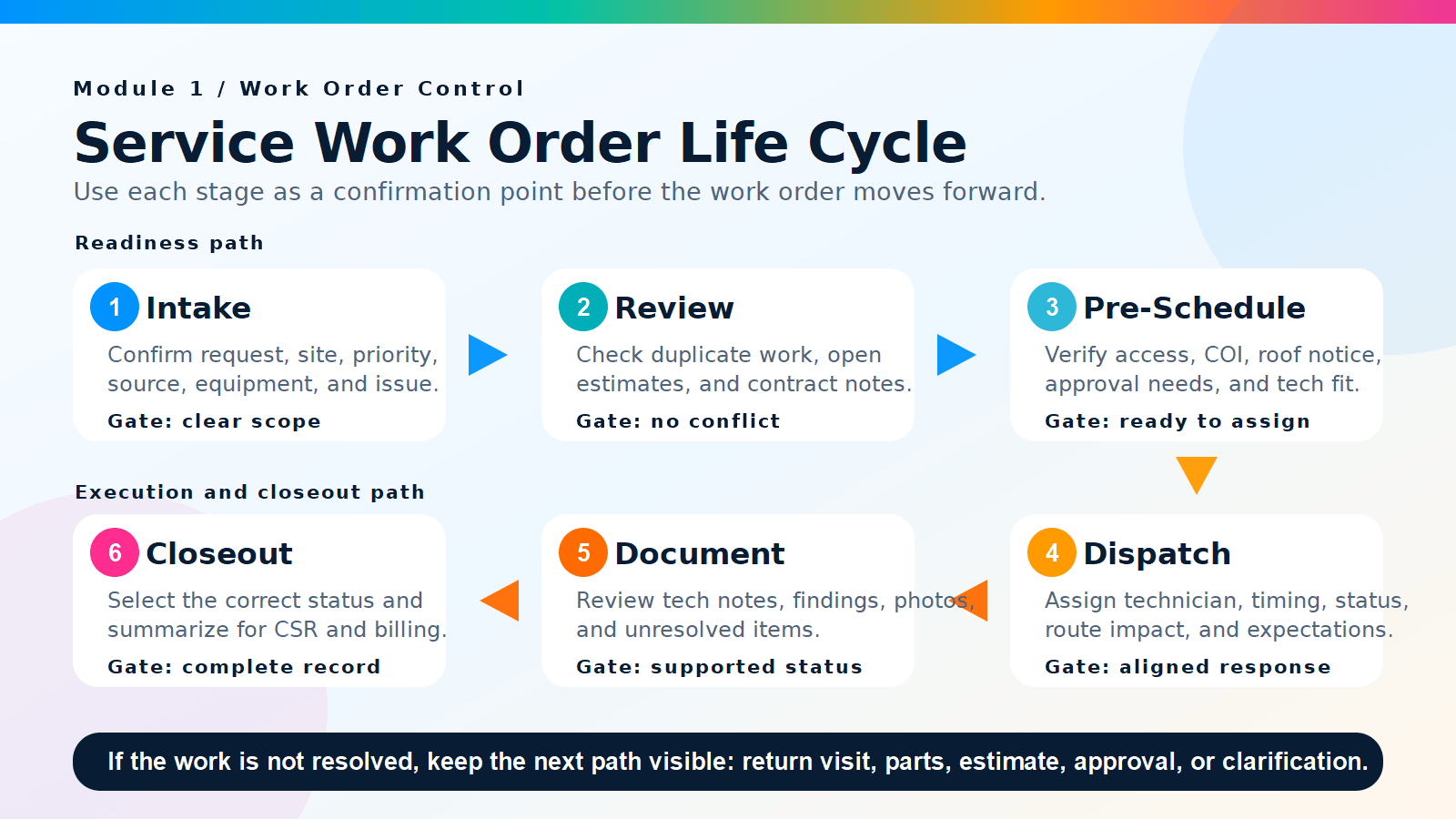

An HVAC dispatcher schedules service calls, assigns technicians, and keeps customers informed about arrival times and delays. Throughout the day, the dispatcher adjusts the schedule as repairs run long, emergencies arrive, or technicians need parts. The job description below covers the duties and skills employers commonly look for.
HVAC dispatcher role definition
An HVAC dispatcher coordinates the timing, assignment, status, and communication of HVAC service work. The dispatcher reviews incoming calls, confirms job information, matches work to technician skill and location, monitors active calls, responds to schedule changes, and keeps the work-order record current.
Company titles vary. “Service dispatcher,” “dispatch coordinator,” and “service coordinator” may describe similar work. Check the job description for who handles incoming calls, purchases parts, approves schedule changes, and follows up on unfinished jobs.
Core HVAC dispatcher responsibilities
Confirm the site, contact, problem, equipment context, access, authorization, priority, and customer commitment.
Build a realistic plan around technician availability, job duration, promised windows, readiness, and operating hours.
Balance geography with skill fit, urgency, capacity, traffic, and the likely effect on later calls.
Track travel, arrival, diagnosis, approval, parts, completion, blocked work, and calls running beyond plan.
Give technicians, customers, managers, and internal teams useful updates when the plan changes.
Keep status, notes, ownership, commitments, blockers, and next actions visible in the system.
HVAC dispatcher job description sample
Position summary
The HVAC Service Dispatcher coordinates daily service demand with technician capacity. This position maintains an accurate service board, schedules and routes qualified technicians, communicates with customers and field staff, monitors active calls, documents changes, and escalates conditions that threaten safety, service commitments, or productive field time.
Essential duties
- Review and prioritize incoming HVAC service requests.
- Confirm work-order details, site access, contacts, authorizations, and job readiness.
- Schedule and route technicians based on skill, geography, urgency, and capacity.
- Monitor active calls and adjust the schedule as conditions change.
- Communicate arrival updates, delays, follow-up requirements, and changed commitments.
- Maintain accurate status, notes, next actions, and ownership in the dispatch system.
- Coordinate parts, vendors, equipment, approvals, and return visits when assigned.
- Escalate emergencies, repeated blockers, missed commitments, and capacity conflicts.
Preferred qualifications
- Service dispatch, scheduling, customer service, or field-service coordination experience
- Clear written and verbal communication
- Strong organization and follow-through
- Comfort working in dispatch or field-service software
- Ability to make calm decisions while priorities change
Employers should customize this sample with their software, service area, on-call expectations, schedule, reporting structure, and specific approval limits.
What a typical HVAC dispatcher day looks like
Confirm attendance, overnight demand, first-job readiness, parts, access, and schedule risks.
Monitor travel and arrivals, assign new calls, correct late starts, and protect customer commitments.
Recalculate remaining capacity, route the afternoon, follow approvals, and communicate delays.
Review open work, missing notes, return visits, parts needs, on-call handoffs, and tomorrow’s opening plan.
For example, if a morning repair runs into the afternoon, the dispatcher checks the technician’s revised finish time, reassigns the next call when possible, and contacts the waiting customer with an updated arrival window.
Skills and judgment the role requires
- Prioritization: assess service urgency using the company’s emergency criteria and customer response commitments.
- Time judgment: recognize when a plan no longer fits the available day.
- Geographic awareness: understand service areas, travel patterns, and route consequences.
- Technical context: capture useful information and match broad work types to technician capability without attempting field diagnosis.
- Communication: give complete, calm updates and confirm that the receiver understands the next action.
- System discipline: keep the work-order platform accurate enough to serve as the operating record.
- Escalation: know when a decision needs service management, technical leadership, sales, parts, or customer authorization.
How HVAC dispatcher performance can be measured
Review call volume alongside schedule accuracy, preventable reschedules, and timely customer updates. Consider factors outside the dispatcher’s control, such as staffing, traffic, parts delays, or a repair taking longer than expected.
| Measure | What it reveals |
|---|---|
| On-time arrival rate | Whether schedule decisions and updates support customer commitments |
| Preventable reschedules | Whether readiness checks are catching missing access, parts, approvals, or skill fit |
| Open jobs without assigned follow-up | Whether unfinished work has someone responsible for the next step |
| On-time customer updates | Whether customers and field staff receive information when promised |
| Board accuracy | Whether system status matches what is actually happening in the field |
Hiring and onboarding an HVAC dispatcher
During hiring, use scenarios instead of relying only on software experience. Ask how the candidate would handle a late technician, a new emergency, an unready crane job, a customer waiting for an update, or two calls requiring the same skill.
First-week onboarding priorities
- Company service area and customer commitments
- Emergency and escalation definitions
- Technician skills and approval limits
- Work-order status and note standards
- Scheduling and readiness rules
- Communication expectations
- Opening, review, handoff, and closeout routines
A consistent training path helps a new dispatcher understand the reason behind the workflow. Review the free HVAC dispatcher training manual and the HVAC Dispatch Certification curriculum when building an onboarding plan.