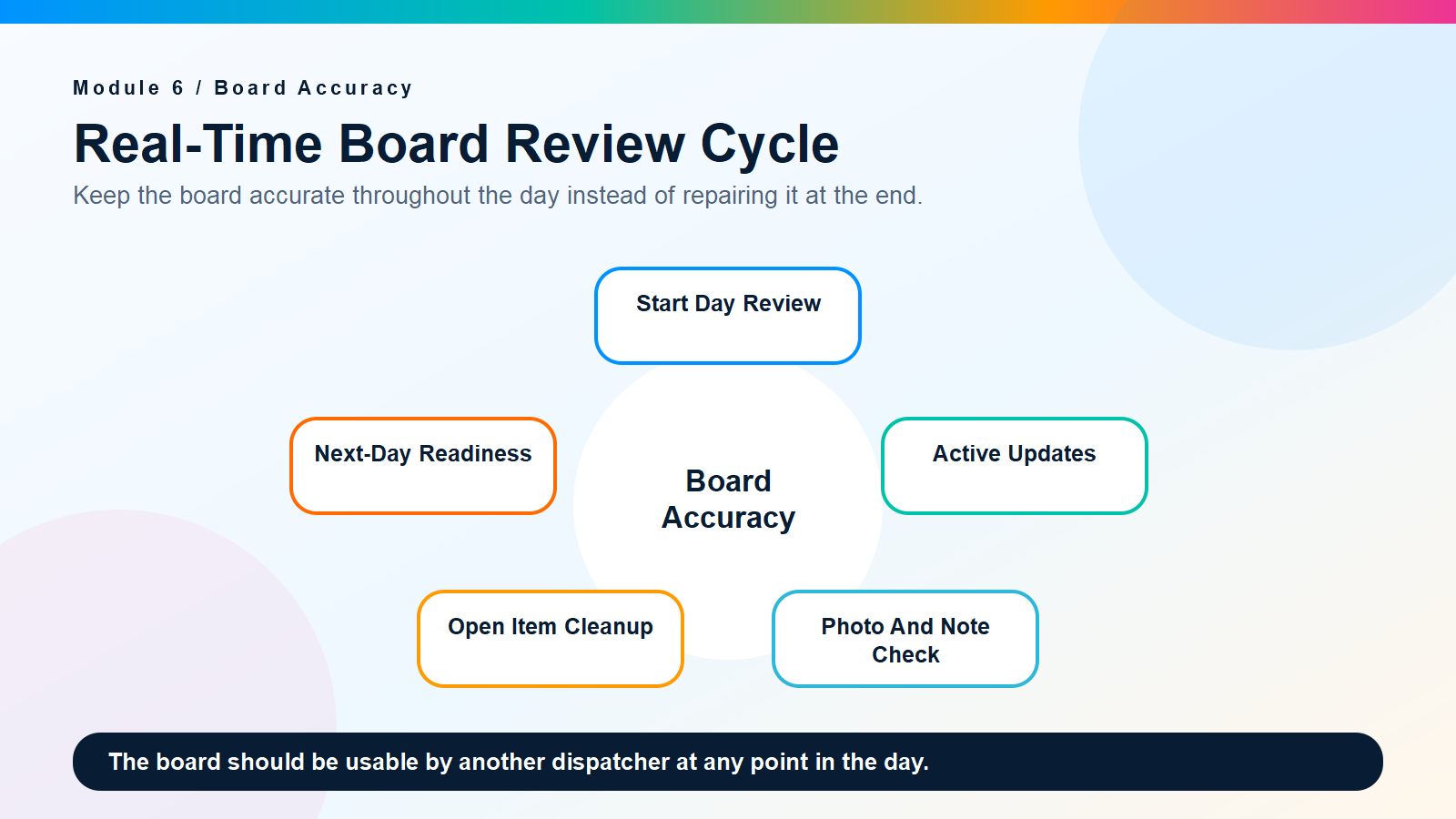

An HVAC dispatch schedule can change quickly when a repair runs long, a part is missing, or an emergency call arrives. These six HVAC dispatching best practices help your team catch those problems early, adjust technician assignments, and keep customers informed. Start with the issue causing the most missed appointments or repeat calls, then use the 30-day plan below to put the changes into practice.
Keep each work order current
Every open job should answer four questions without requiring a phone call or private message:
Use a defined status that matches the real condition of the work.
Name the person or team responsible for the next action.
Record a specific action, not a vague holding phrase.
Set a date, time, or operating threshold for follow-up.
This structure makes the dispatch board usable during shift changes, emergencies, absences, and high-volume periods.
Best practice 1: schedule ready work
Before placing a job on a technician’s route, confirm that the visit can produce a useful result. Check the site contact, access, scope, equipment context, required authorization, parts, permits, special equipment, and customer commitment.
If a replacement motor has not arrived, record who is checking delivery and when they will report back. Confirm the part is correct and the technician can access the equipment before promising a repair date. Use the job-readiness checklist to cover the other requirements.
Best practice 2: match technician skills, timing, and location
Shortest drive time is only one part of a good route. Consider technician skill, job duration, promised window, equipment type, customer access, current location, overtime exposure, parts availability, and the effect on later calls.
- Filter by capability. Which technicians can perform the work?
- Check readiness and time. Which option fits the actual visit requirements?
- Compare geographic cost. Which route protects productive time?
- Test the rest of the day. What commitments move if this assignment runs long?
- Document the decision. Make special instructions and customer promises visible.
Example: the nearest technician has another commitment
A qualified technician is ten minutes from a new no-cooling call but has a confirmed appointment in thirty minutes. Another qualified technician is finishing a job twenty-five minutes away with an open afternoon. After checking the new call’s urgency and the second technician’s finish time, you may be able to assign the new call without moving the confirmed appointment. Compare the whole schedule before choosing the shortest drive.
Best practice 3: review late, blocked, and unassigned calls
Review the board at defined points, then focus attention on exceptions. Useful exception views include:
- Technicians not traveling or arriving as expected
- Jobs running beyond their planned duration
- Unassigned urgent work
- Customers due for an update
- Calls waiting on authorization or parts
- Completed visits missing useful notes or next actions
- Tomorrow’s work that is not ready
Confirm uncertain statuses with the technician and record the next action. A job marked “on site” for hours may need a parts decision, customer authorization, or a revised completion estimate.
Best practice 4: update customers before an arrival window is missed
Do not wait for a customer to ask where the technician is. Set update times, watch the conditions that threaten them, and communicate early enough for the customer or technician to adjust.
| Audience | Useful update |
|---|---|
| Customer | Current arrival expectation, reason for a meaningful change, next action, and next update time |
| Technician | Site contact, scope, access, priority, parts or equipment, customer promise, and known constraints |
| Manager | Decision needed, operating impact, available options, and recommended next step |
| Next shift | Current status, owner, blocker, commitment, and follow-up time |
Best practice 5: use a written emergency playbook
Define what qualifies as an emergency, who can authorize after-hours or premium work, which customers have contractual response rules, and who must be notified when normal capacity cannot meet demand.
When an emergency enters the board, control both sides of the change. Assign the emergency, then identify every appointment or task it displaces. Notify affected people, document the revised plan, and set the next review point.
Best practice 6: measure outcomes dispatch can influence
Does system status match field reality?
How often does scheduled work arrive with the required information and coordination?
Are promised customer and internal updates completed on time?
How many return visits or reschedules begin with an avoidable dispatch gap?
For a weekly review, count the planned repair visits that needed a return trip because access, parts, or authorization was missing. Divide that count by the planned repair visits reviewed, and record the reason for each return. Compare the same job types over time; a diagnostic visit that identifies a part to order should be tracked separately from a repair sent out without a part already known to be needed.
A 30-day HVAC dispatch improvement plan
- Week 1: define the board.
Agree on status names, ownership, next-action language, and review thresholds.
- Week 2: install readiness checks.
Create minimum information and coordination requirements for common job types.
- Week 3: standardize communication.
Set customer-update rules, technician handoff fields, and escalation formats.
- Week 4: review outcomes.
Audit a small sample of delayed, rescheduled, returned, and successfully completed jobs. Keep the standards that changed the result.
For a step-by-step foundation, use the HVAC dispatcher training manual. Employers building a shared training standard can also review the HVAC Dispatch Certification curriculum.